

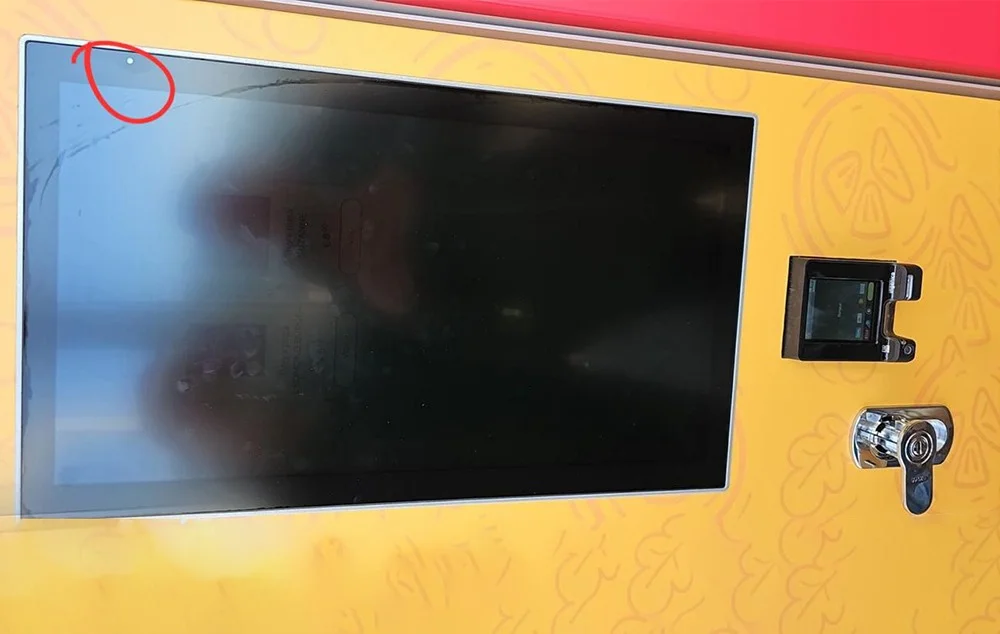
When a vending machine manufacturer in Italy reached out to us, he had a clear picture of what he needed. His machines were going outside, in full sunlight, running all day. He needed an outdoor touchscreen monitor for vending machines that could actually hold up in those conditions. Not something that looks good in a spec sheet, but something that works in the field.
He asked for four specific things: 1000-nit high brightness, optical bonding, an anti-glare surface, and a 10-point capacitive touch system. We built exactly that. The screens shipped, the machines went live, and for the first couple of months, everything worked the way it should.
Why Outdoor Touchscreen Monitor for Vending Machines Need a Different Kind of Display
Most people do not think about the display when they use a vending machine. They tap, they select, they pay and they leave. But behind that simple interaction is a screen that has to perform reliably in rain, cold, heat, and direct sunlight day after day.
In countries like Germany, the Netherlands, France, Spain, and Poland, Outdoor Touchscreen Monitor for Vending Machines deal with serious environmental stress. Summers bring intense UV exposure. Winters bring condensation and near-freezing temperatures. A standard commercial display is not built for any of this. That is why operators in these markets specifically look for sunlight readable displays with industrial-grade components.
Our Italian customer understood this. Here is what each of his requirements actually solves in a real outdoor environment:
- 1000 nits brightness: Below this level, a screen becomes washed out in direct sun. Users cannot read prices, product names, or payment instructions. For outdoor kiosk displays, 1000 nits is the starting point, not a premium feature.
- Optical bonding: Without bonding, there is an air gap between the LCD and the cover glass. That gap causes internal reflections that make the image look faded or doubled in bright light. Optical bonding eliminates that gap permanently and also prevents condensation from forming inside the display.
- Anti-glare coating: Even a bright screen can be hard to use if it reflects the sun back at the user. An anti-glare surface scatters that reflected light so the content remains readable. For a vending machine screen in a sunny Spanish street or a French outdoor market, this is not optional.
- 10-point PCAP capacitive touch: Projected capacitive touch is the same technology used in modern smartphones. It supports multi-touch, responds accurately to light contact, and with proper firmware tuning, it works even with gloves or in damp conditions. This matters a lot for outdoor installations in Germany and Poland where cold weather means gloved users.
Building the Screens: What We Actually Put Into Each Unit
Once we understood the full requirement, our engineering team put together a configuration specifically for outdoor vending machine use. This was not a standard product pulled off a shelf. Each display was built with the deployment environment in mind.
The key specifications we locked in:
- High brightness LCD panel at 1000 cd/m squared, enough to stay clearly visible during peak afternoon sunlight hours across southern Europe
- Full optical bonding between the cover glass and the LCD panel, giving the display a clean, solid appearance and preventing any light path reflections or internal fogging
- Anti-glare surface treatment across the full viewing area, so the screen content stays dominant even when ambient light is strong
- 10-point PCAP touch controller with outdoor-optimized sensitivity settings, making the screen responsive under both dry and slightly damp conditions
- Wide temperature operating range, allowing the display to function stably from cold northern European winters to hot Mediterranean summers
- Ruggedized housing designed for public-facing vending machine and self-service kiosk environments
We completed manufacturing, ran quality checks, and shipped the displays to Italy. The customer installed them in his vending machines and started his outdoor deployment.
The Problem That Showed Up After Two Months
The first two months went smoothly. Then the customer noticed something. In direct sunlight, particularly during the hottest part of the afternoon, the screens were not holding up the way they had been. The brightness seemed inconsistent. The display was harder to read than it had been when the machines first went live.
He called us. He was calm and clear about what he was seeing, and we appreciated that. A clear problem description is the fastest path to a real solution.
Our technical team started running tests. We looked at the panel itself. We checked the optical bonding. We tested the anti-glare coating. We ran the touch controller through diagnostics. Everything on the display side was within specification.
The problem was the power supply. It was not rated to sustain the current draw needed to keep a 1000-nit industrial display running at full brightness in high ambient temperatures. When the machines sat in direct sunlight for hours, the internal temperature of the cabinet rose. The power supply started struggling under the combined heat and load. The result was voltage instability, which caused the display brightness to drop.
This is a known issue in outdoor display engineering that is easy to overlook. A high brightness panel running at 1000 nits draws significantly more power than a standard display. That power demand has to be matched by every component in the system, including the power supply. If the supply is undersized even slightly, sustained outdoor operation will reveal it.
What We Did to Fix It
We did not waste time. Once we had identified the power supply as the cause, we sourced a heavy-duty industrial replacement that was properly rated for the sustained power demand of the 1000-nit display under high-temperature outdoor conditions.
The replacement unit was selected based on:
- Sufficient wattage to support the display at full brightness continuously without throttling
- A wide operating temperature tolerance so it could handle both the heat of southern European summers and the cold of northern winters
- Stable voltage output under variable load, which is critical in outdoor environments where conditions change throughout the day
- Industrial-grade build quality suitable for 24-hour vending machine operation
We shipped the replacement power supply to Italy as quickly as we could. The customer installed it, ran the machines through a full day of outdoor operation including direct afternoon sunlight, and confirmed the problem was gone. The screens were stable, bright, and performing exactly as they should.
A problem that started as a field complaint became a lesson in complete system design for outdoor kiosk displays. Every component in the installation has to be matched to the demands of the environment. The display was right. The power supply was not. Once that was corrected, everything worked.
What Vending Machine Manufacturers Should Know Before Deploying Outdoor Screens
This case study is useful beyond Italy. Any vending machine operator or manufacturer deploying outdoor touchscreens across Europe should think through these points before installation.
Match your power supply to your display brightness
A 1000-nit sunlight readable touchscreen draws more power than a standard display. The power supply in your vending machine cabinet needs to be rated for that sustained load, especially in hot outdoor environments. This is the single most common oversight we see in outdoor display deployments.
Optical bonding is a requirement, not an upgrade
An air-gap display will struggle outdoors. Optically bonded displays maintain contrast and clarity in bright conditions, resist internal condensation, and have longer operational life in temperature-variable environments. For outdoor vending in the Netherlands, France, or Spain, bonded panels are the baseline.
Think about touch performance in your specific climate
A PCAP capacitive touch screen needs to be tuned for outdoor conditions. Rain sensitivity, glove compatibility, and ghost touch prevention all require firmware configuration that differs from indoor deployments. Manufacturers shipping to Germany or Poland need to account for cold weather glove use. Those in Spain or France need to consider humidity and occasional rain.
Thermal management matters as much as the panel spec
A high-brightness industrial touchscreen monitor generates heat. The cabinet it sits in must have adequate ventilation or active cooling to prevent thermal buildup. In a sealed outdoor vending machine enclosure under direct sun, temperatures can reach levels that affect display performance and component life if thermal management for outdoor displays is not considered from the start.
After-sales support is part of what you are buying
The most important thing our Italian customer said after we resolved the issue was that he felt confident in us as a long-term partner. He knew we would respond, diagnose, and fix the problem. For vending machine manufacturers scaling across multiple European markets, that reliability from a display supplier is as valuable as the product specification itself.
How Baobao Technology Supports Vending Machine Manufacturers in Europe
Baobao Technology designs and manufactures industrial touchscreen monitors and touchscreen computers for demanding real-world deployments. Our products are used in Outdoor Touchscreen Monitor for Vending Machines, self-service kiosks, industrial control panels, and point-of-sale systems across Europe and globally.
For vending machine manufacturers and kiosk integrators in Spain, Germany, the Netherlands, France, and Poland, we offer:
- Custom outdoor touchscreen monitor configurations from 10 to 55 inches
- Sunlight readable display options from 700 nits to 2500 nits depending on deployment environment
- Optical bonding and anti-glare coating for outdoor vending and kiosk applications
- 10-point PCAP and infrared touch options with outdoor-optimized firmware
- Full OEM and ODM services from component to finished integrated display system
- CE-compliant products ready for European market deployment
- Technical support and RMA service available within Europe
We work directly with manufacturers to understand the deployment environment before we specify the display. That means fewer surprises in the field and faster resolution when something does go wrong.
If you are a vending machine manufacturer or kiosk integrator planning an outdoor deployment in Germany, France, the Netherlands, Spain, Poland, or anywhere else in Europe, we are ready to help you get the full system right from the start. Contact Baobao Technology today to discuss your outdoor touchscreen display requirements.
Frequently Asked Questions
What brightness level does an outdoor vending machine touchscreen need?
For outdoor use in direct sunlight, the minimum recommended brightness is 1000 nits (cd/m squared). Below this level, screen content becomes difficult or impossible to read in bright conditions. For installations in very sunny locations such as southern Spain or exposed urban areas in France, some operators choose panels rated at 1500 nits or higher. Our high brightness touchscreen monitors are available in configurations from 700 nits to 2500 nits.
What is optical bonding and why does it matter for outdoor vending machine displays?
Optical bonding is a process where the cover glass and the LCD panel are laminated together with a clear adhesive, eliminating the air gap that normally exists between them. That air gap causes internal reflections that make the image look faded or washed out in bright light. An optically bonded display eliminates this effect, improves contrast, prevents internal condensation, and generally makes the screen more durable in outdoor conditions. For any outdoor vending or kiosk application, optical bonding is strongly recommended.
Can a capacitive touchscreen work outdoors in rain or with gloves?
Yes, but only if it is properly configured for outdoor use. A standard PCAP capacitive touch screen designed for indoor use may register false touches from water droplets or fail to respond to gloved input. Outdoor-optimized touch controllers use firmware tuning to filter rain interference and increase sensitivity for gloved touch. This is particularly important for vending machines deployed in Germany, Poland, or the Netherlands where cold weather and rain are common.
Why did our outdoor touchscreen vending machine screen lose brightness in sunlight?
This is usually a power supply issue, which is exactly what happened with our Italian customer. A 1000-nit sunlight readable display draws significantly more power than a standard screen. If the power supply in the vending machine cabinet is not rated for that sustained load, especially in high ambient temperatures, it will struggle to maintain full brightness. The display throttles down as a result. The fix is to replace the power supply with a properly rated industrial unit.
What is the difference between anti-glare coating and optical bonding?
These are two separate features that solve different problems. Anti-glare coating is applied to the surface of the cover glass. It works by scattering reflected ambient light so that glare does not overpower the screen image. Optical bonding works internally by eliminating the air gap between the cover glass and the LCD. A well-specified outdoor touchscreen monitor for vending machines should ideally have both.
Conclusion:
Choosing an outdoor touchscreen monitor for vending machines comes down to understanding the full system, not just the display panel. The screen brightness, bonding type, touch technology, power supply, and thermal management all have to work together under real outdoor conditions.
Our Italian customer’s experience is a clear example of what happens when one component is not matched to the others. The display was excellent. The power supply was not. Once that single issue was corrected, the machines performed exactly as intended.
If you are a vending machine manufacturer or kiosk integrator planning an outdoor deployment in Germany, France, the Netherlands, Spain, Poland, or anywhere else in Europe, we are ready to help you get the full system right from the start. Contact Baobao Technology today to discuss your outdoor touchscreen display requirements.